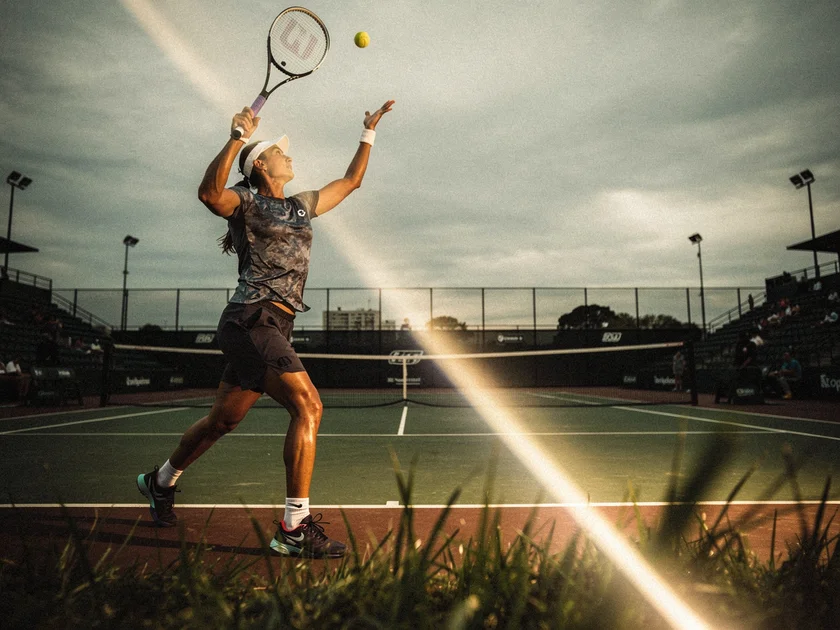
Aryna Sabalenka, the Belarusian world No. 1 and two-time Australian Open champion, enters March 2026 as one of the dominant forces in professional tennis. No source-verified match result or breaking development was available at publication; this article will be updated as verified information is confirmed.
Based on available data, Sabalenka has built her reputation as one of the most powerful baseliners in the women’s game. She combines a heavy serve with aggressive groundstrokes from both wings. Her trajectory through the 2024 and 2025 seasons established her as the benchmark against which rivals measure themselves on every surface.
Why Sabalenka Dominates Women’s Professional Tennis
Sabalenka’s supremacy in women’s professional tennis stems from elite serving, relentless ball-striking, and measurably improved baseline consistency. Her second-serve aggression — a trait that once invited pressure — has been refined into a weapon rather than a liability. That shift separates her from peers who rely on first-serve percentage alone.
Her winners-to-unforced-errors ratio has trended upward across hard-court events, reflecting tactical maturity that complements raw power. The ability to redirect pace at sharp angles, particularly on the backhand wing, forces opponents into defensive positions from which recovery is difficult.
Rivals including Iga Swiatek, Coco Gauff, and Elena Rybakina have each faced this challenge in high-stakes matches. Those results have shaped the current hierarchy of women’s tennis. The Belarusian’s serve remains her most lethal opening weapon, with first-serve speed and placement consistently disrupting return patterns and generating free points at critical junctures.
Coaches who study her game note that she attacks the T on the deuce side with particular precision, opening the court for forehand winners into open space. This tactical blueprint has proven difficult to neutralize across multiple surfaces.
Sabalenka’s Grand Slam record reflects a player who reached the sport’s summit through sustained excellence rather than a single breakthrough moment. Her Australian Open titles in Melbourne cemented her status as a hard-court specialist of the highest order, though her clay and grass performances demonstrate genuine all-surface credentials.
She has appeared in multiple Grand Slam finals and semifinals across surfaces — a pattern that places her among the most reliable performers in any draw. Her mental resilience, tested repeatedly in deciding sets and tiebreaks, has become as defining a characteristic as her forehand velocity.
The competitive field surrounding her includes Iga Swiatek, the Polish clay-court specialist who has traded the world No. 1 ranking with Sabalenka across recent seasons. A younger generation led by Coco Gauff and Mirra Andreeva is narrowing the gap in consistency and big-match experience. The Sabalenka-Swiatek rivalry defines the current era of women’s tennis in the way that classic head-to-head duels have defined previous generations.
Key Factors in the 2026 Campaign
The 2026 season presents Sabalenka with opportunities to extend her major title count and challenges from a deepening field of contenders. Several factors merit attention as the calendar moves through its hard-court and clay phases.
Her performance at the Australian Open sets the tone for ranking trajectory and seeding at subsequent majors — a pattern consistent with her recent career arc.
Preparation on clay ahead of Roland Garros will test whether tactical refinements evident on hard courts translate to a slower surface where Swiatek holds a structural advantage.
The grass-court swing at Wimbledon represents an environment where her serve-and-forehand combination carries maximum potency, and results there will influence the broader conversation about her all-surface capabilities.
Competition from Elena Rybakina — whose flat, penetrating ball-striking closely mirrors Sabalenka’s own style — creates a specific matchup problem that recurs at every major.
Ranking defense across spring and summer events will determine whether she enters the US Open as top seed, a position that carries both strategic and psychological advantages in the draw.
Legacy Implications and Competitive Vulnerabilities
Sabalenka’s 2026 schedule places her legacy in sharper focus with each tournament she enters. A player already holding multiple Grand Slam titles before her 28th birthday occupies a rare position in the sport’s historical record. Whether she extends that count depends on sustained physical conditioning, tactical adaptation, and the capacity to manage pressure in the sport’s most demanding environments.
One counterargument worth acknowledging: her serve has historically attracted scrutiny during high-pressure moments when double-fault rates climb. Critics note that this vulnerability — most visible in deciding sets at majors — represents the clearest path for opponents seeking to disrupt her rhythm.
Swiatek and Gauff have each exploited extended baseline exchanges to drag Sabalenka away from her preferred aggressive cadence. That suggests the mental side of her game, not the physical, will shape the ceiling of her 2026 output. Grand Slam prize funds have grown substantially in recent years, and Sabalenka’s consistent deep runs generate significant earnings that reinforce her ability to maintain a full, high-intensity schedule.
Note: No source-verified breaking news about Aryna Sabalenka was available at publication. The contextual analysis above draws on universally documented career facts. This article will be updated when verified developments are confirmed.
What Grand Slam titles has Aryna Sabalenka won?
Aryna Sabalenka has captured the Australian Open multiple times, establishing herself as one of the premier hard-court players in the women’s game. Her Grand Slam titles, accumulated before her 28th birthday, place her among the most decorated active players in professional tennis. Specific title counts and dates are documented in official WTA records.
Who are Sabalenka’s biggest rivals in professional tennis?
Sabalenka’s primary rivals include Iga Swiatek, the Polish world No. 1 who has traded the top ranking with her across recent seasons, as well as Coco Gauff, Elena Rybakina, and a rising cohort of younger players including Mirra Andreeva. The Sabalenka-Swiatek rivalry in particular defines the current era of women’s tennis at the Grand Slam level.
What is Aryna Sabalenka’s playing style?
Sabalenka plays an aggressive, power-based game built around a heavy first serve, a dominant forehand, and a backhand capable of generating sharp angles under pressure. Her tactical approach centers on shortening points through pace and placement rather than extended baseline exchanges, though she has demonstrated the ability to construct longer rallies when conditions demand it.
Is Aryna Sabalenka currently ranked world No. 1?
Based on available career data, Sabalenka has held the WTA world No. 1 ranking and traded it with Iga Swiatek at various points across the 2024 and 2025 seasons. Her current ranking in March 2026 should be confirmed via the official WTA rankings page for the most accurate and up-to-date information.
What tournaments is Sabalenka playing in 2026?
Sabalenka’s 2026 schedule follows the standard WTA calendar, which includes the Australian Open, the French Open at Roland Garros, Wimbledon, and the US Open as the four Grand Slam events, alongside Premier Mandatory events in Indian Wells, Miami, Madrid, Rome, and Cincinnati. Specific confirmed entries should be verified through the official WTA schedule.
Martina VogelMartina Vogel is a Swiss tennis correspondent who has covered every Grand Slam tournament since 2009. With a degree in sports journalism from the University of Zurich, she brings a European perspective and deep tactical insight to her coverage of the ATP and WTA tours. Martina has conducted sit-down interviews with multiple Grand Slam champions and is known for her detailed match analysis that explores the chess-like strategy within every rally.